
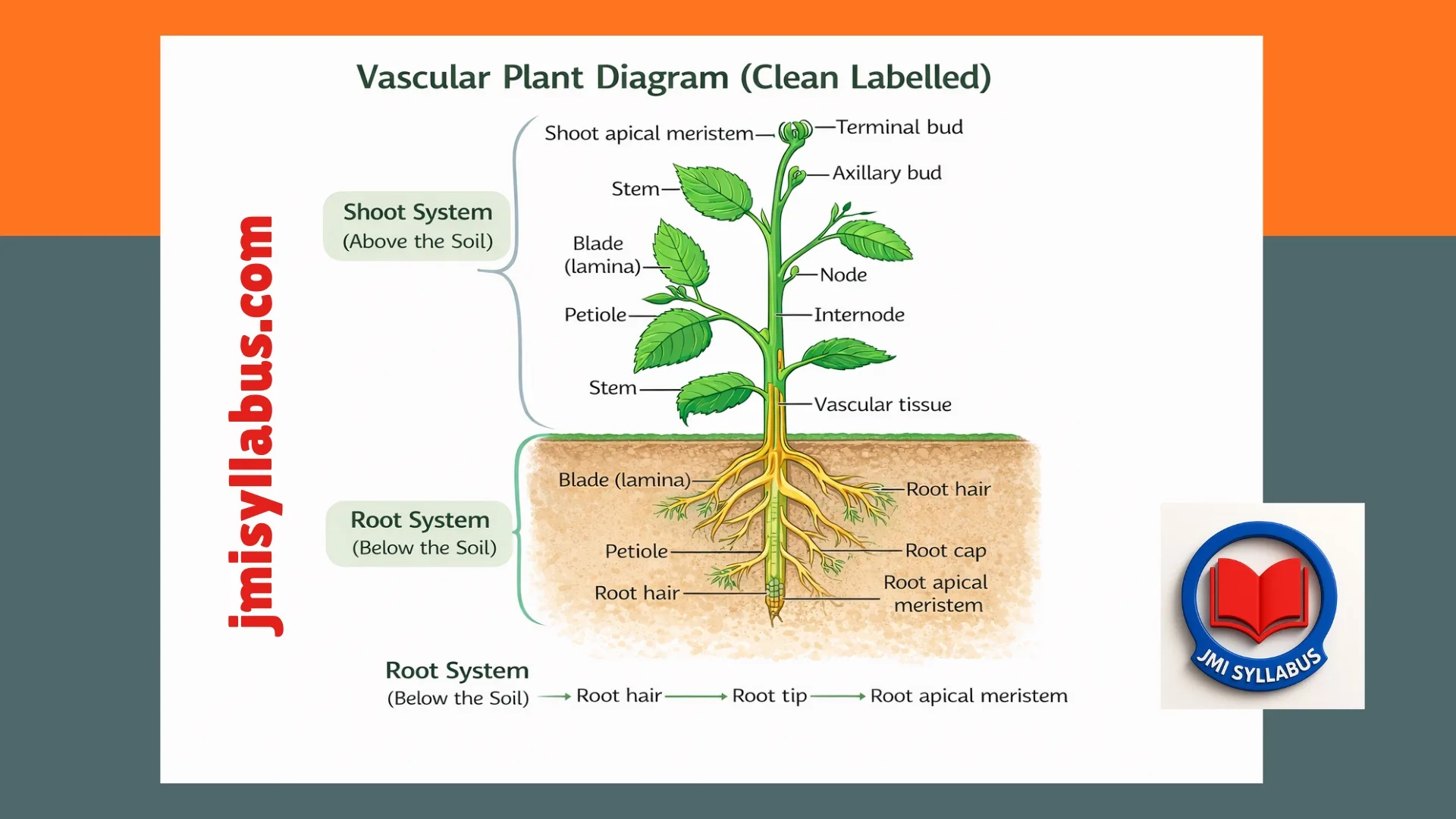
If you are confused by the Vascular Plant Diagram, this post will make it simple in one read. The Vascular Plant Diagram shows two main parts of a plant body—the shoot system above the soil and the root system below the soil—along with the key points where growth and transport happen. You will learn the meaning of every label in the diagram, the definition of each part, and easy examples so you can remember it for exams and school notes.
Vascular Plant Diagram: What It Shows
A vascular plant is a plant that has a proper transport system inside it. In simple words, a vascular plant has special tissues that carry water and minerals from roots to leaves and carry food from leaves to the rest of the plant.
- A vascular plant is called “vascular” because it contains vascular tissue that works like internal pipes.
- A vascular plant is usually stronger and taller than non-vascular plants because transport is faster and more organised.
- Common examples of vascular plants include rose, mango, wheat, sunflower, neem, and money plant.
What Is a Vascular Plant?
A vascular plant is a plant that contains xylem and phloem for transport of materials, so it can move water, minerals, and food efficiently to different parts of the plant.
- A vascular plant uses xylem mainly to move water and minerals upward from the roots.
- A vascular plant uses phloem mainly to move prepared food from leaves to all parts of the plant.
- A vascular plant shows clear division into shoot system and root system, as shown in the Vascular Plant Diagram.
Two Main Systems in a Vascular Plant (Easy Overview)
1. Shoot System (Above the Soil)
The shoot system is the part of the plant body that grows above the ground. It includes the stem, leaves, nodes, internodes, and buds.
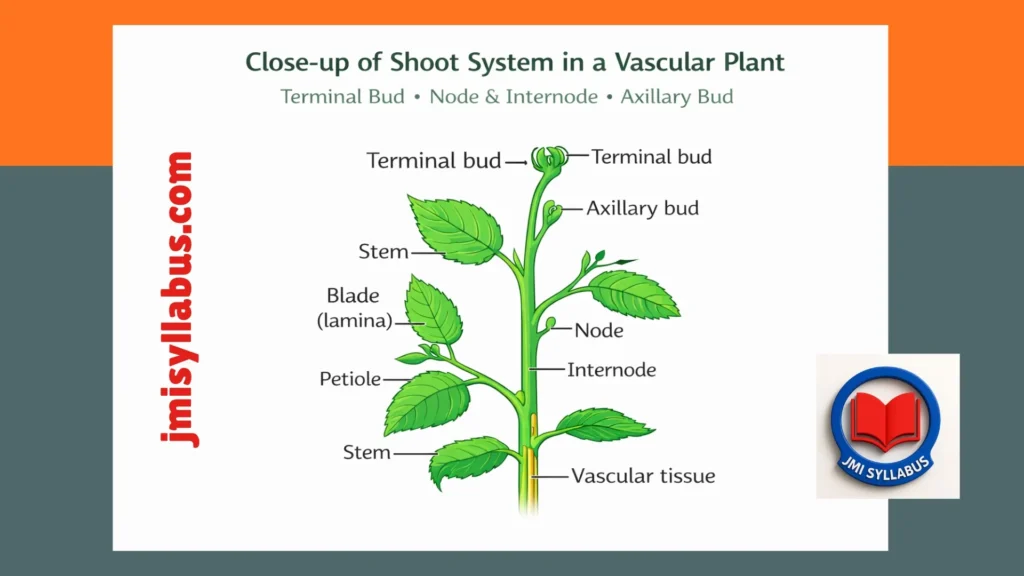
- The shoot system helps the plant stand upright and spread leaves to capture sunlight.
- The shoot system also carries transport tissues to move water upward and food to different regions.
- For example, in a rose plant, the stem, leaves, and buds that you see above soil are the shoot system.
2. Root System (Below the Soil)
The root system is the part of the plant body that grows inside the soil. It includes the primary root, side roots, root hairs, root tip, root cap, and root apical meristem.
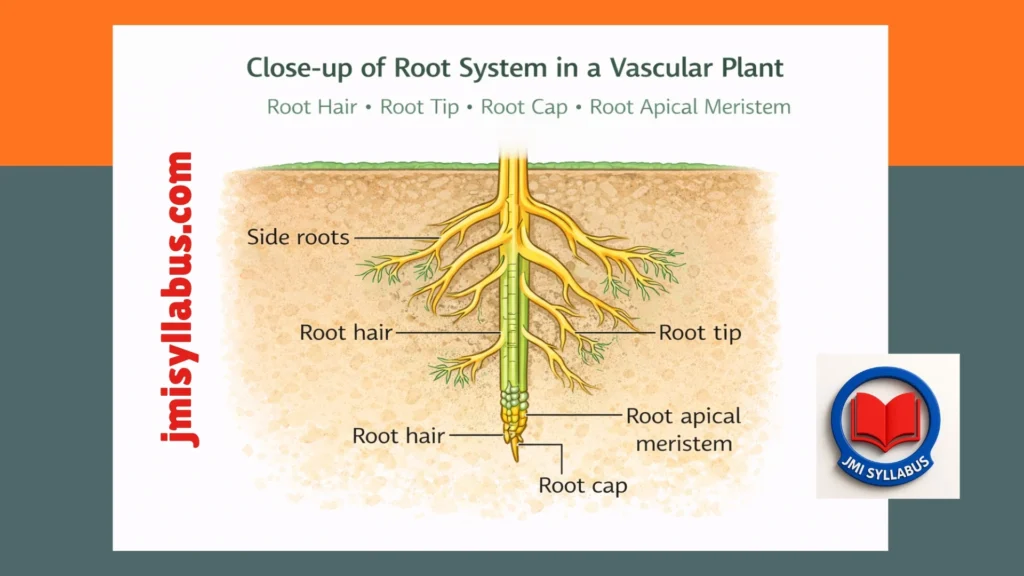
- The root system anchors the plant firmly in the soil so it does not fall.
- The root system absorbs water and minerals, mainly with the help of root hairs.
- For example, in wheat, the roots spread in soil and absorb water quickly, especially due to many fine root hairs.
How to Read a Vascular Plant Diagram in 30 Seconds
To understand any Vascular Plant Diagram, follow a simple order from top to bottom.
- First, you should identify the terminal bud and the shoot apical meristem because these show the main growth point at the top.
- Next, you should notice the leaves and their parts, because leaves are responsible for preparing food.
- After that, you should focus on node and internode, because they explain where leaves and buds form and how the stem length increases.
- Finally, you should look at the root region and locate the root hair, root tip, root cap, and root apical meristem, because these show absorption and root growth.
JMI No.1 Guide: Original Previous Year Papers + Complete Entrance Exam Guide (UG)


The Conceptum JMI UG Entrance ke liye agar aap fast, smart, aur exam-ready preparation chahte hain, to ye combo aapke liye best choice hai. Isme aapko JMI Entrance Exam Guide ke saath Original Previous Year Papers milte hain, jisse aap real exam pattern, important topics, aur scoring questions ko quickly samajh kar confident practice kar sakte hain. BBA, B.Com, BA, BHM, BTTM aur Social Work jaise courses ke liye ye set complete, trusted, aur highly useful hai—jisse aapki preparation easy, clear, aur result-oriented ban jaati hai.
Shoot System Parts
Stem
The stem is the main upright part of the shoot system that supports the plant and connects leaves with roots.
- The stem holds leaves, buds, and branches in a proper position so the plant can receive sunlight.
- The stem contains vascular tissue, so it helps move water from roots to leaves and food from leaves to the rest of the plant.
- For example, in a sunflower, the thick stem supports the heavy flower and also carries water upward quickly.
Leaf
A leaf is a flat green part of the shoot system that mainly prepares food for the plant through photosynthesis.
- A leaf captures sunlight, takes carbon dioxide from air, and uses water to produce food.
- A leaf also helps in transpiration, which supports upward water movement in xylem.
- For example, in a money plant, broad leaves help the plant prepare more food and grow faster.
Leaf Blade / Lamina
The leaf blade (lamina) is the broad, flat surface of the leaf.
- The leaf blade is the main area where photosynthesis happens because it receives maximum sunlight.
- The leaf blade usually has veins that contain xylem and phloem for transport inside the leaf.
- For example, in a mango leaf, the lamina is long and broad and clearly shows veins.
Petiole
The petiole is the stalk that connects the leaf blade to the stem.
- The petiole holds the leaf blade in a way that it can receive more sunlight and air.
- The petiole also helps transport water to the leaf and food away from the leaf.
- For example, in hibiscus, you can clearly see the petiole connecting the leaf to the stem.
Node and Internode (Most Scoring Diagram Labels)
Node
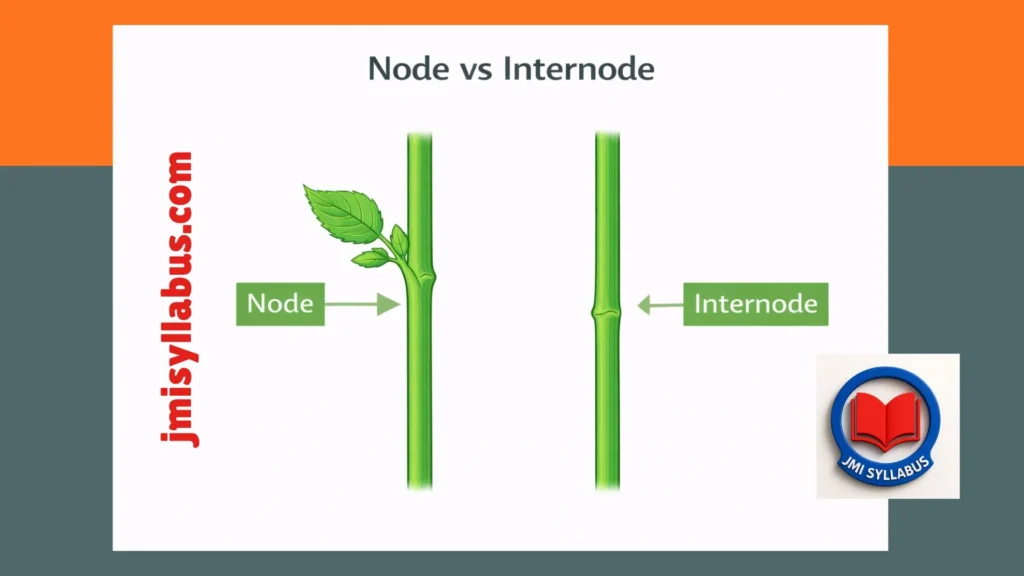
A node is the point on the stem where a leaf, bud, or branch arises.
- A node is important because it is the place where new growth can start.
- A node often shows an axillary bud in the angle between leaf and stem.
- For example, in rose, new branches often come out from nodes where axillary buds are present.
Internode
An internode is the part of the stem between two consecutive nodes.
- An internode helps in increasing plant height because stem elongation happens by lengthening of internodes.
- Longer internodes create more spacing between leaves, which can help leaves get sunlight without shading each other.
- For example, in sugarcane, internodes are clearly visible and long, which is why sugarcane stem looks segmented.
Buds in the Shoot System
Terminal Bud
The terminal bud is the bud present at the top end of the main stem.
- The terminal bud is responsible for upward growth because it contains actively dividing cells.
- The terminal bud helps the plant increase its height and form new leaves at the top.
- For example, in a young mango plant, the terminal bud helps the plant grow taller each season.
Axillary Bud
The axillary bud is the bud present in the angle between the leaf and the stem, usually at the node.
- The axillary bud helps the plant form branches, making the plant bushier.
- The axillary bud can also develop into flowers in many plants.
- For example, in rose, axillary buds often develop into side branches and flower-bearing shoots.
Shoot Apical Meristem
The shoot apical meristem is a region of actively dividing cells located at the shoot tip.
- The shoot apical meristem causes primary growth, which means increase in length of the shoot.
- The shoot apical meristem forms new tissues like young leaves and stem parts.
- For example, when you see a plant producing new leaves at the top, that growth is happening due to the shoot apical meristem.
Root System Parts (Complete Explanations)
Root Hair
A root hair is a tiny hair-like outgrowth from the root surface that increases the absorbing area.
- Root hairs absorb water and dissolved minerals from the soil efficiently.
- Root hairs are very important because without them the plant would absorb much less water.
- For example, in wheat, thousands of fine root hairs help the plant absorb water quickly after irrigation.
Root Tip
The root tip is the growing end of the root.
- The root tip is where new root cells are produced, so the root increases in length.
- The root tip helps the root move deeper into soil to search for water and minerals.
- For example, when a seed germinates, the first thing that grows downward is the root tip.
Root Cap
The root cap is a protective covering over the root tip.
- The root cap protects the delicate growing region from damage caused by soil particles.
- The root cap also helps the root push through soil smoothly.
- For example, when roots grow through hard soil, the root cap prevents direct injury to the root tip.
Root Apical Meristem
The root apical meristem is a region of actively dividing cells near the root tip.
- The root apical meristem forms new cells that increase root length.
- The root apical meristem ensures continuous root growth so the plant can absorb more water and minerals.
- For example, in a developing seedling, rapid root growth happens because the root apical meristem is very active.
Vascular Tissue (Xylem vs Phloem with Examples)
Vascular Tissue
Vascular tissue is the transport system inside a vascular plant that helps movement of materials.
- Vascular tissue is mainly made of xylem and phloem.
- Vascular tissue is present in roots, stems, and leaves, which is why transport happens throughout the plant body.
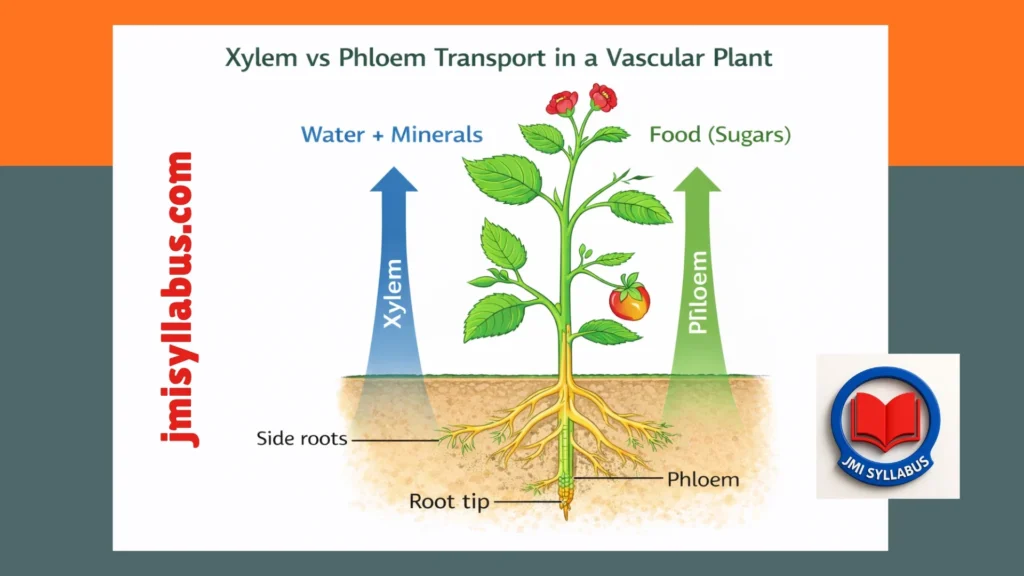
- In the Vascular Plant Diagram, vascular tissue is shown inside the stem region as the main transport pathway.
Xylem
Xylem is the tissue that transports water and minerals from roots to the upper parts of the plant.
- Xylem mostly carries water upward, which is why it is often called the water-carrying tissue.
- Xylem helps leaves get water for photosynthesis and also supports the plant body.
- For example, in a tall coconut tree, xylem continuously moves water upward to reach high leaves.
Phloem
Phloem is the tissue that transports prepared food from leaves to all parts of the plant.
- Phloem carries sugars made in leaves to stems, roots, fruits, and growing regions.
- Phloem transport can happen in different directions depending on the need of the plant.
- For example, in potato, phloem carries food to underground parts where it gets stored.
Transport Path in a Vascular Plant (Easy Flow You Can Memorise)
This is the quickest way to understand the Vascular Plant Diagram transport concept.
- Water usually moves as: Root hair → root → xylem → stem → leaf.
- Food usually moves as: Leaf → phloem → stem → roots/flowers/fruits.
- For example, after photosynthesis, food made in leaves travels through phloem to developing fruits in plants like tomato.
Common Confusions (Clear Differences with Examples)
Node vs Internode
- A node is the exact point where leaves and buds originate, like the place where a new branch can start in a rose plant.
- An internode is the segment between two nodes, like the visible segments in sugarcane stem.
Terminal Bud vs Axillary Bud
- A terminal bud is at the top and mainly increases height, like the top bud of a young mango plant.
- An axillary bud is on the side at a node and mainly forms branches, like side buds in rose that form new flowering shoots.
Root Cap vs Root Hair
- A root cap protects the root tip during soil penetration, like a helmet protecting the growing root.
- Root hairs absorb water and minerals, like tiny sponges increasing absorption area.
Quick Revision Summary
- A vascular plant is a plant that contains xylem and phloem for transport of water, minerals, and food.
- The shoot system includes stem, leaves, buds, nodes, and internodes, and it mainly works above the soil.
- The root system includes root hairs, root tip, root cap, and root apical meristem, and it mainly works below the soil.
- The terminal bud and shoot apical meristem help the shoot grow longer from the top.
- The axillary bud helps the plant form branches and sometimes flowers from the side.
- The node is the place where leaves and buds arise, while the internode is the region between two nodes.
- Root hairs absorb water and minerals efficiently by increasing surface area.
- Vascular tissue includes xylem for water transport and phloem for food transport.
Practice Questions (Exam-Oriented)
-
Define a vascular plant and name its transport tissues.
A vascular plant is a plant that has a well-developed transport system to carry water, minerals, and food through the plant body. In the Vascular Plant Diagram, this transport system is shown as vascular tissue. The two main transport tissues in a vascular plant are xylem (which carries water and minerals) and phloem (which carries prepared food).
-
Explain the difference between node and internode with one example each.
In a vascular plant, a node is the point on the stem where leaves, buds, or branches arise, such as the place on a rose stem where a leaf and an axillary bud are attached. An internode is the part of the stem between two nodes, such as the long segment seen between two leaf-attachment points in sugarcane. In the Vascular Plant Diagram, node and internode help you understand where growth and leaf arrangement occur.
-
What is the role of root hairs in absorption?
Root hairs play a major role in absorption because they increase the surface area of the root and help the plant absorb more water and dissolved minerals from the soil. In a vascular plant, root hairs act like tiny extensions that pick up water efficiently, which is why the Vascular Plant Diagram shows root hairs near the root region where absorption is maximum.
-
Differentiate between xylem and phloem with one example of transport.
The root cap is important because it protects the root tip and the root apical meristem (the growing region) when the root pushes through the soil. It acts like a protective covering that reduces damage from hard soil particles and helps the root move forward smoothly. The root cap also releases a slippery substance (mucilage), which makes it easier for the root to penetrate soil and continue proper growth, as shown in the Vascular Plant Diagram.
-
Why is the root cap important for root growth inside soil?
The root cap is important because it protects the delicate root tip and the root apical meristem (growing region) when the root pushes through soil. In a vascular plant, the root cap works like a safety cover that prevents injury from soil particles and helps the root move forward smoothly, which supports proper root growth as shown in the Vascular Plant Diagram.