
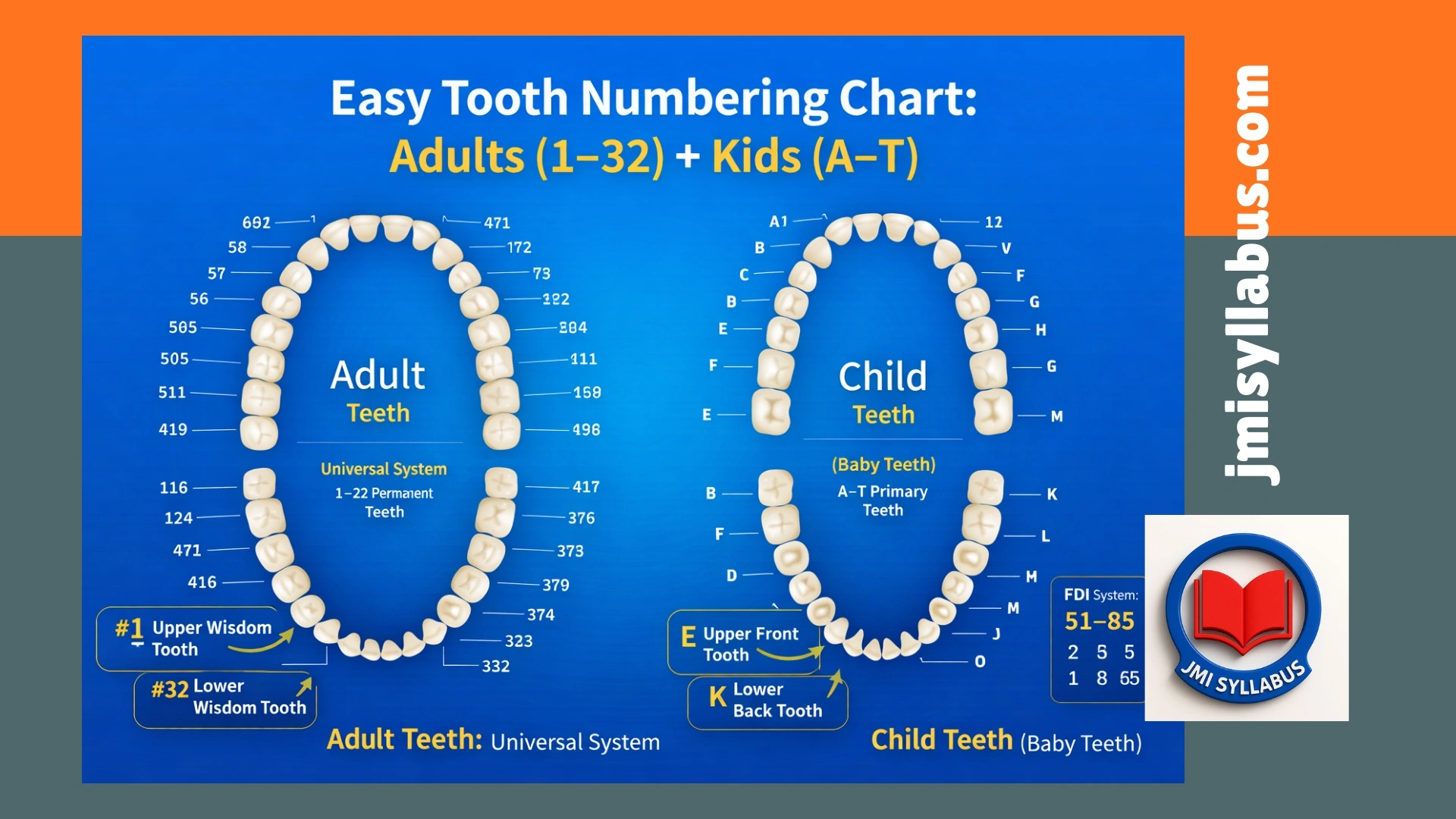
Easy Tooth Numbering Chart 1–32 (Universal System): Adult + Child Teeth Guide (Complete)
If you’ve ever read a dental slip that says “RCT #19” or “Extraction #32” and felt unsure, you’re not alone. Dentists use tooth codes to avoid confusion, but patients and students often struggle to decode them. This complete guide explains the Easy Tooth Numbering Chart 1–32 (Universal System) in a simple, practical way—so you can locate any tooth quickly and understand common dental notes with confidence.
This post covers both adult (permanent) teeth and child (primary/baby) teeth, because kids do not use #1–#32 in the same way. You’ll also find an easy baby teeth chart (A–T) and an FDI primary teeth chart (51–85), plus real examples used in dental prescriptions and reports.
What Is Tooth Numbering and Why Does It Matter?
Tooth numbering is a standardized method that assigns a unique code to each tooth. It helps dentists communicate clearly during:
- diagnosis and treatment planning
- X-rays and case records
- fillings, crowns, RCT, extractions
- insurance and referral notes
With a clear tooth numbering chart, you can immediately understand which tooth is being discussed—especially when notes are short and technical.
Adult vs Child Teeth: The Big Difference
Before using any dental tooth chart numbers, you must first identify whether the patient is an adult or a child.
Adults (Permanent Teeth)
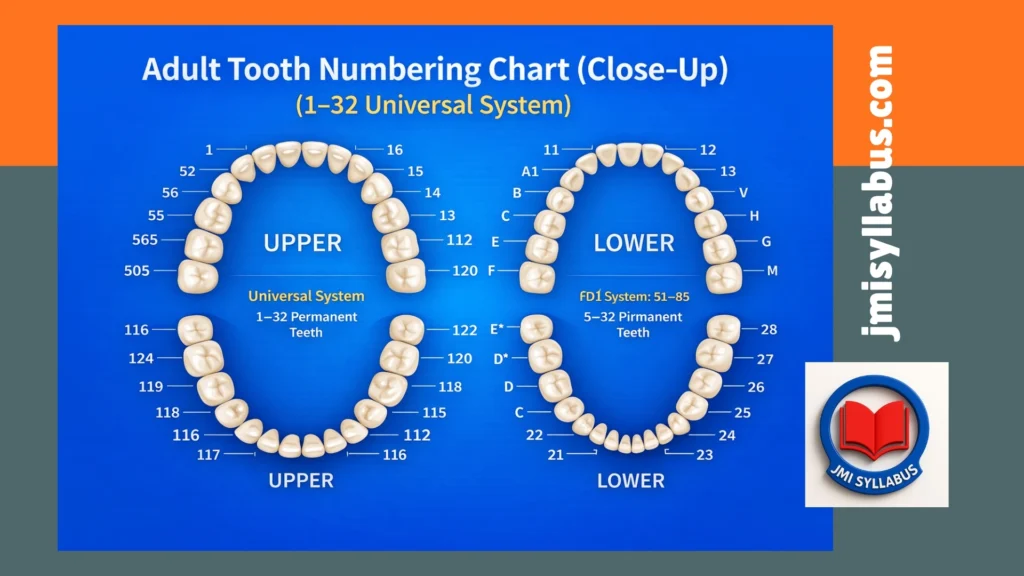
- Total permanent teeth: 32
- Common chart: Universal tooth numbering system
- Codes: #1 to #32
- Upper teeth: #1–#16
- Lower teeth: #17–#32
Children (Primary/Baby Teeth)
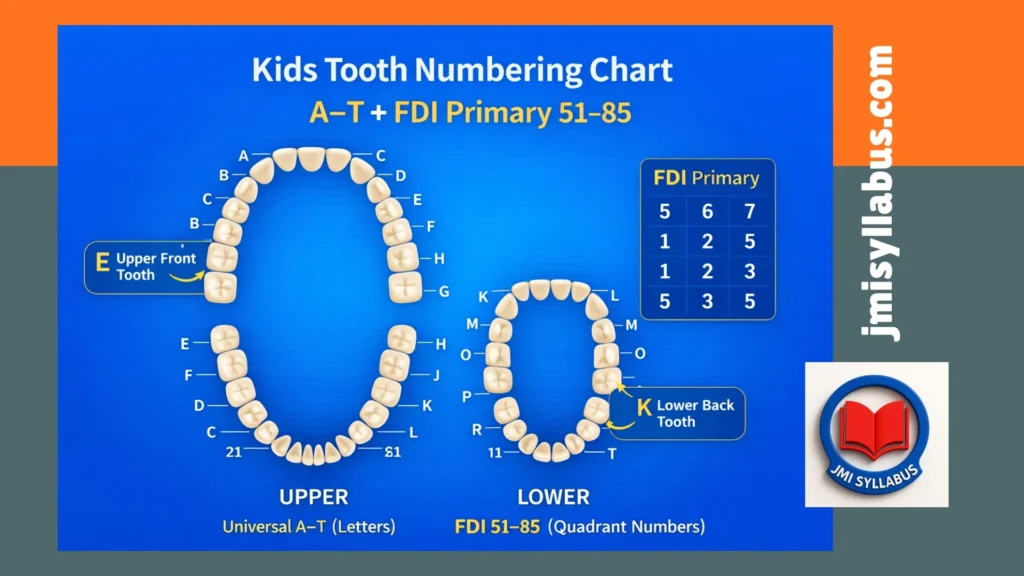
- Total primary teeth: 20
- Codes are usually:
- A–T (letters) in the Universal primary system, OR
- FDI primary teeth chart: 51–85 (two digits)
This is why mixing charts causes confusion. A child’s “E tooth” is not the same as an adult’s #8 tooth. Once you know the patient type, the chart becomes easy.
Patient Right vs Left: The Rule That Prevents Confusion
In dentistry, right and left are always from the patient’s perspective, not the viewer’s.
So “upper right” means the patient’s upper right, even if it looks reversed when you are facing them.
Adult Teeth: Universal Tooth Numbering System (1–32)
The Universal system labels adult teeth from #1 to #32.
Upper Teeth Numbers (1–16)
Numbering starts at the upper right third molar and moves across to the upper left third molar:
- #1 – Upper right third molar (wisdom)
- #2 – Second molar
- #3 – First molar
- #4 – Second premolar (second bicuspid)
- #5 – First premolar (first bicuspid)
- #6 – Canine (cuspid)
- #7 – Lateral incisor
- #8 – Central incisor
- #9 – Central incisor
- #10 – Lateral incisor
- #11 – Canine (cuspid)
- #12 – First premolar
- #13 – Second premolar
- #14 – First molar
- #15 – Second molar
- #16 – Upper left third molar (wisdom)
Lower Teeth Numbers (17–32)
Numbering continues on the lower arch from left to right:
- #17 – Lower left third molar (wisdom)
- #18 – Second molar
- #19 – First molar
- #20 – Second premolar
- #21 – First premolar
- #22 – Canine (cuspid)
- #23 – Lateral incisor
- #24 – Central incisor
- #25 – Central incisor
- #26 – Lateral incisor
- #27 – Canine (cuspid)
- #28 – First premolar
- #29 – Second premolar
- #30 – First molar
- #31 – Second molar
- #32 – Lower right third molar (wisdom)
Quick adult anchors (most searched):
- Wisdom teeth: #1, #16, #17, #32
- Upper front centers: #8, #9
- Lower front centers: #24, #25
- First molars: #3, #14, #19, #30
Tooth Types Explained (Incisors, Canines, Premolars, Molars)
Understanding tooth types makes any tooth chart for patients easier:
- Incisors (front cutting teeth): central + lateral incisors
- Canines (cuspids): pointed tearing teeth
- Premolars (bicuspids): chewing support teeth
- Molars: heavy grinding teeth (first, second, third molars)
- Wisdom teeth: third molars at the far back
This also helps when reports mention “first molar” instead of the number.
Child Teeth: Primary/Baby Teeth Chart (A–T)
Children have 20 primary teeth. Many dentists use letters A to T:
Upper Primary Teeth (A–J)
- A – Upper right second molar
- B – Upper right first molar
- C – Upper right canine
- D – Upper right lateral incisor
- E – Upper right central incisor
- F – Upper left central incisor
- G – Upper left lateral incisor
- H – Upper left canine
- I – Upper left first molar
- J – Upper left second molar
Lower Primary Teeth (K–T)
- K – Lower left second molar
- L – Lower left first molar
- M – Lower left canine
- N – Lower left lateral incisor
- O – Lower left central incisor
- P – Lower right central incisor
- Q – Lower right lateral incisor
- R – Lower right canine
- S – Lower right first molar
- T – Lower right second molar
Easy memory for kids:
- Upper central baby incisors: E and F
- Lower central baby incisors: O and P
- Back baby second molars: A, J, K, T
Child Teeth: FDI Primary Teeth Chart (51–85)
Some clinics use the FDI system for kids:
- Quadrants (primary):
- 5 = upper right, 6 = upper left
- 7 = lower left, 8 = lower right
- Tooth positions from midline:
- 1 central incisor → 5 second molar
Examples:
- 51 = upper right primary central incisor
- 55 = upper right primary second molar
- 61 = upper left primary central incisor
- 74 = lower left primary first molar
- 85 = lower right primary second molar
If you see codes like 54, 61, or 85, it’s likely an FDI dental tooth chart.
How to Read Dental Notes (Adult + Child Examples) — Extra Clear Version
In dental prescriptions and reports, dentists usually mention two things:
- Treatment (RCT, Filling, Extraction, Crown, Scaling, etc.)
- Tooth Code
- Adults: written as #Number (Universal System #1–#32)
- Children: written as Letters (A–T) or FDI two-digit codes (51–85)
Step 1: First identify the patient type
Before you decode any tooth number/letter, confirm whether the patient is an adult or a child:
- Adult / Permanent teeth → #1–#32 (Universal Numbers)
- Child / Primary (Baby) teeth → A–T (Letters) or FDI: 51–85
Once you confirm the patient type, 90% of the confusion disappears, and reading dental notes becomes much easier.
Adult Examples (Universal Numbers)
- “RCT #19” → Root canal on lower first molar (tooth #19 meaning)
- “Extraction #32” → Removal of lower right wisdom tooth (tooth #32 meaning)
- “Filling #8” → Filling on upper front central incisor
- “Crown #14” → Crown on upper first molar (tooth #14 meaning)
Child Examples (Letters A–T)
- “Filling E” → Filling on upper right baby central incisor (tooth E meaning)
- “Pulp therapy K” → Treatment on lower left baby second molar (tooth K meaning)
- “Extraction T” → Removal of lower right baby second molar
Child Examples (FDI 51–85)
- “Restoration 54” → Filling on upper right baby first molar
- “Caries 61” → Decay in upper left baby central incisor
- “Extraction 85” → Removal of lower right baby second molar
Easy Tooth Numbering Chart 1–32 Universal System: Quick Memory Tricks
To remember tooth numbering faster, use these patterns:
- Upper front centers: #8 and #9
- Lower front centers: #24 and #25
- Wisdom teeth: #1, #16, #17, #32
- First molars: #3, #14, #19, #30
- Baby upper centers: E & F
- Baby lower centers: O & P
These are high-importance teeth numbers that appear often in dental reports.
Easy Tooth Numbering Chart 1–32 Universal System vs FDI: What’s the Difference?
- Universal (Adults): #1–#32
- Universal (Kids): A–T
- FDI (Kids): 51–85
- FDI (Adults): two-digit codes (international format)
So, if your note says #19, it’s Universal adult numbering. If it says E or 85, it’s a child tooth chart.
Most-Asked Quick List (Perfect for Fast Reading)
- Wisdom teeth: #1, #16, #17, #32
- Adult first molars: #3, #14, #19, #30
- Adult upper front: #8, #9
- Baby upper front: E, F
- Baby lower back ends: K, T
- FDI kids key ends: 55, 65, 75, 85
FAQs
What is tooth #19?
Tooth #19 is the lower first molar, commonly treated for cavities and RCT.
What is tooth #14?
Tooth #14 is the upper first molar, a major chewing tooth.
Which teeth are wisdom teeth in adults?
Wisdom teeth are #1, #16, #17, #32.
What does tooth E mean in kids?
E is the upper right primary central incisor (baby front tooth).
What does FDI 85 mean?
85 is the lower right primary second molar in children.
Final Takeaway
Use the Universal numbers #1–#32 for adults and the A–T or FDI 51–85 chart for kids. Once you match the correct chart to the patient type, tooth codes become simple and easy to understand. This guide is designed to be a clear, high-quality reference for students, patients, and anyone reading a dental prescription.